

Having Fun With Nature
Roses







Tips
| Vegetables | Herbs | Flowers | Roses | Propagation | Landscaping |

Copyright © Red Gate Farm 2012. All rights reserved.

Suggested Rose Suppliers
We have purchased roses from these companies with good results. This is not an ad, just an opinion.
Chamblee's Rose Nursery
10926 US Highway 69N
Tyler, TX 75706
(800) 256-7673
www.chambleeroses.com
Antique Rose Emporium
10000 FM50
Brenham, TX 77833
(800) 441-0002
www.antiqueroseemporium.com
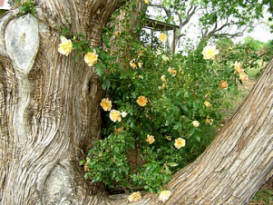
Clytemnestra in an Ashe Juniper
Roses - You Really Can Grow Them!
So many times we've heard folks say, "Oh, I can't grow roses!" What they really mean is that they've gotten the wrong rose for the wrong spot. Anyone can grow roses as long as you're willing to do a little research into what the rose is and what it likes.
Here, in Texas, we have trouble keeping grafted roses alive. We treat them as short-lived perennials. However, the "antique or "own root" roses, which grow on their own roots and have survived on their own at old homesteads and in graveyards for years, do extremely well.
Antique roses also thrive in most of the United States and don't require much care.

Choosing Your Rose
There are lots of rose types - floribundas, Bourbons, polyanthas, Chinas, teas, ramblers, miniatures, gandifloras, climbers - and each has its own special attraction. Choose a rose because you like its color, its scent, and because it will fit in the space you intend for it. Read the tag that comes with it, and believe it.
Climbers don't really climb since they don't have tendrils. They have to be tied and trained until they get large enough for their canes to be woven in the trellis. As you might expect, Ramblers do just that. They are well suited for draping over fences.
Chinas, floribundas, grandifloras, and Bourbons are big, showy, and usually fragrant. They make a statement in your garden. They are less adapted for being cut and


Black Spot Prevention
There is no cure, only prevention. Once a rose has it, the leaves fall off and the rose is weakened, but not fatally.
To prevent black spot
- Plant your roses in the sun
- Provide good air circulation
At the first sign of black spot, remove the diseased leaves. If a rose is prone to black spot it will probably get it during the humid days of mid-summer.
Do not fertilize the rose: that only encourages cane growth and leaves and increases the stress on the plant.
Clytemnestra
put in a vase than teas, but they do make a good smelling bouquet.
Polyanthas have smaller blooms with fewer petals, but are great for border planting where you want a smaller rose bush.
Antique roses are the ones your great grandmother had. They grow on their own root and are not grafted, they have scent, and they're not delicate. Antiques are now becoming the choice of many gardeners. You may want to stay away from two antique roses: Mermaid and Lady Banks. These roses will take over. We had a Lady Banks that was tearing the roof off our workshop!
Rose Care
First the bad news: roses get "black spot" which is black spots on the leaves causing the leaves to drop; they can
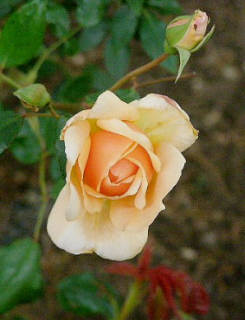
Bon silene
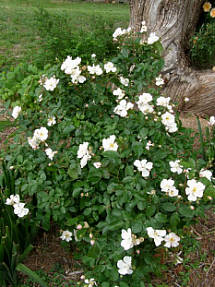

get powdery mildew in humid situations without good air circulation; and, some roses tend to "ball" in humid weather which means their buds turn brown and do not form roses. Now for the good news: black spot is not fatal, a few leaves fall off (see "Tips"); powdery mildew can be treated with a fungicide you can make (see "Tips"); and, balling only happens under certain conditions and then only to a few buds.
We "dead head" (cut off the spent bloom) our roses because the antiques form "hips" (seed pods) after blooming. Once the hips form the rose thinks its duty is done and will bloom less, sending most of its energy into pod formation. All you do is cut the bloom off at the first joining of 5 or 7 leaves. Dead heading encourages growth and bloom.
Fertilize in the spring when the little red leaves first start to appear. We use well rotted cow manure, but any well balanced fertilizer will do. We also give ours a boost in early
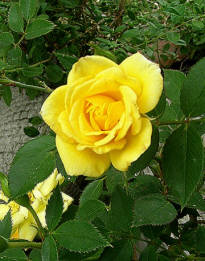

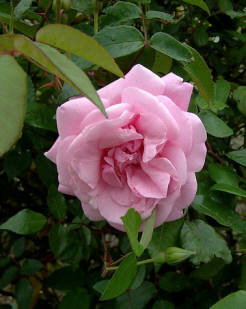
Marie Pavie
fall for the fall flush of flowers. But we live in a mild climate. Those of you in the north should not fertilize in the fall since it encourages new growth that will get frozen.
The Rose Bed
Planting your roses together is an invitation for disease and pests to stop by and infect all of your plants. Roses massed together are fine, if you have the time and are willing to frequently spray them.
Most roses prefer 6 or more hours of sunshine and some protection from the wind. The soil should be good, and amended with compost or similar. Good drainage, soil that's not compacted, and some organic matter is a great start for successful roses.
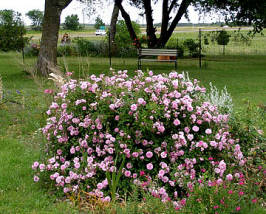

Rise n Shine
Caldwell Pink
Roses are so lovely, they deserve a setting that emphasizes their color, size, and growth pattern. By scattering your roses in various flower beds, you not only get more "oomph" from your roses, you protect them from diseases and insects. Low growing plants set off your roses and the roses bring attention to less showy plants.
Our roses are in 4 different flower beds and on the fence. They're positioned so that we are able to see and smell them while doing normal outside activities. And while having the roses where you can easily see and enjoy them, it's not a good idea to have them near a path...they are "armed with thorns".

Alternative Organic Fungicide
A mixture of 1 part milk and 9 parts water is also a very good fungiside.
You may use powdered or liquid milk, just not evaporated. The proportions aren't critical, just make sure you have more water than milk

Organic Fungicide
This will prevent or cure powdery mildew.
Dissolve 1 tsp. of baking soda and ½ tsp. of vegetable oil into a pint of water (if using tap water let sit for 24 hours for the chemicals to dissipate).
Shake well and spray on affected roses.